
As a student learning to throw a pot on the wheel, we hear the phrase “lift the wall”. This is perhaps not a correct turn of phrase. Due to the ordinary dynamics of working with a lump of clay on a wheel, the student usually ends up with a thick base and a thin top. Maybe some potters have not had this issue, but I found I had to seriously apply myself to improve my practice. I wanted to have a thin base right from the start. This is not so strange for many potters, but it plagues many others. The tendency is to simply try “lifting” the clay and gradually the application of force ends up tapering to the top, leaving a thick base and a thin top. What is required is some technique applied at the base before “lifting”.
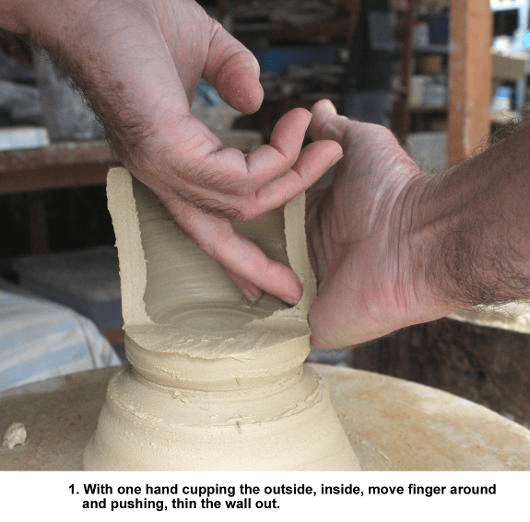
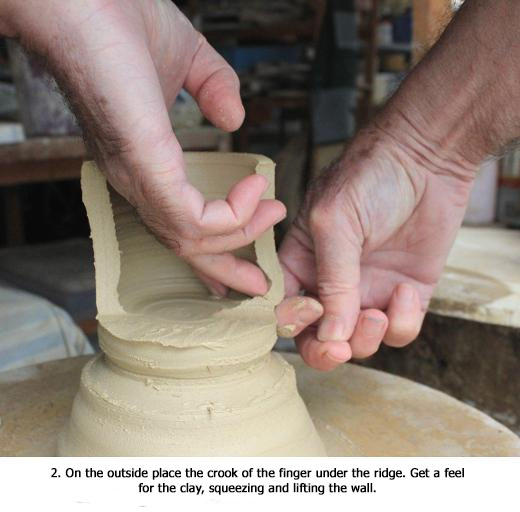
After opening up the hump, inside at the base, the fingers push out on the wall a little, or wiggle around a bit on the wall. At the same time the other hand or fingers are restraining the wall on the outside. This pressure from inside makes a slight ridge in the wall. Right from the start, thin it out as thin as you want the wall to be in the end product, at least as thin as you can. Then with the outside fingers under the ridge, applying a squeeze between the inner and the outer, the ridge can be felt to be running over the fingers. With the rotation of the wheel, there will be a natural rise of the clay over the fingers and up the wall. At first it is best not to try to do anything fully all at once. So you can just go up a short section, and repeat it. Then do a bit more further up, or go back to the base again, and so on, squeezing and rising, rather than “lifting”.
 Peter's Art & Craft